The Berkeley startup takes some of the backbreaking work out of many labor-intensive jobs.
BERKELEYSIDE – April 6, 2026
For all the marvels of modern robotics, the most advanced machinery for general dexterity is still the human body.
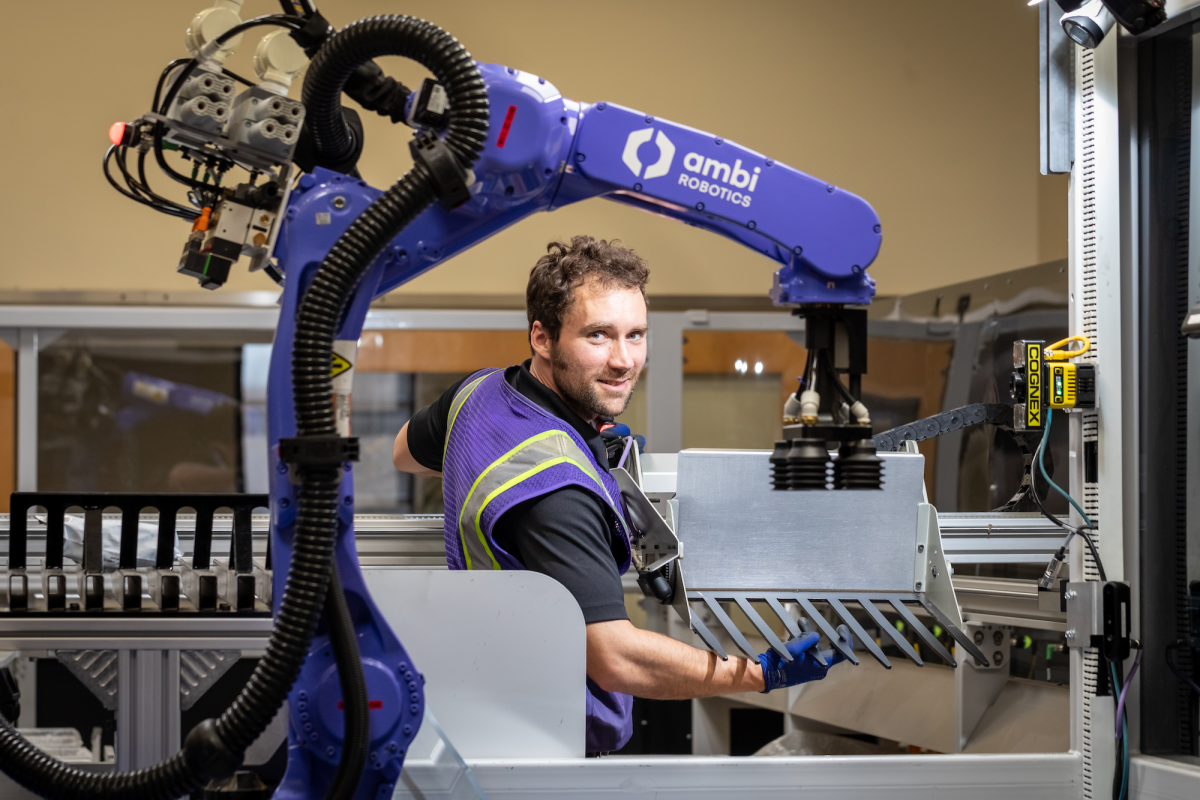
There’s been this long-standing problem in robotics, where things that are very hard for humans are relatively easy for robots and things that are easy for humans are very hard for robots,” said Jeff Mahler, co-founder and chief technology officer of Ambi Robotics. The West Berkeley-based company’s tagline is “empowering people to handle more.”
While robots excel at precise, repetitive, high-speed movements, Mahler said, they also struggle to “pick up simple items and manipulate them. Even doing our laundry is extremely difficult.”
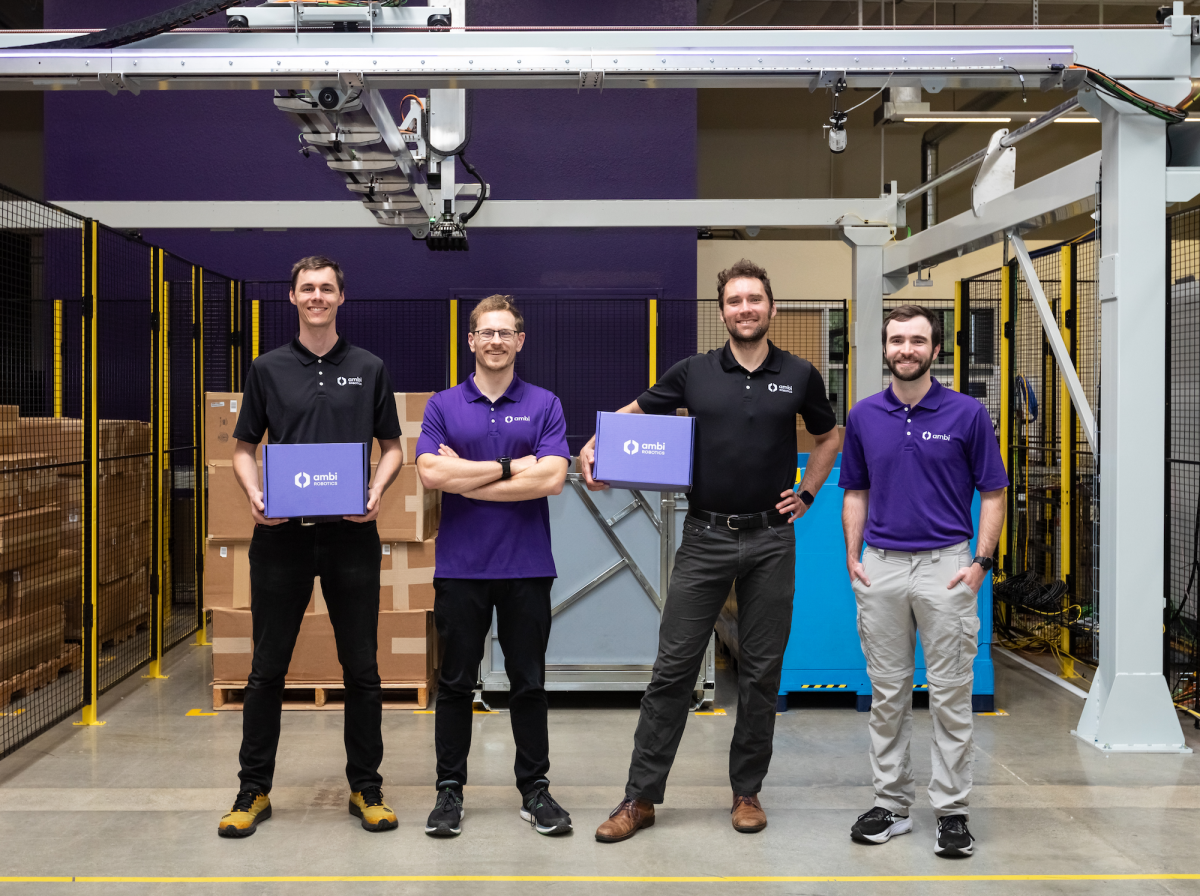
Mahler and his co-founders, fellow UC Berkeley doctoral grads Stephen McKinley, David Gealy and Matt Matl, along with their Professor Ken Goldberg, started the business in 2018 with the goal of narrowing the dexterity gap between humans and robots. The company traces its origins to their research in Professor Goldberg’s AUTOLab at UC Berkeley.
“I started my Ph.D. around 2012, when deep neural networks (machine learning algorithms modeled after the human brain’s neural structure) were just coming out,” said Mahler. “We started a research project, Dex-Net, exploring how we could use advances in AI to teach robots to pick up items they’ve never seen before and improve the dexterity that they lack compared to humans.”
But there was an obstacle. (Of course.)
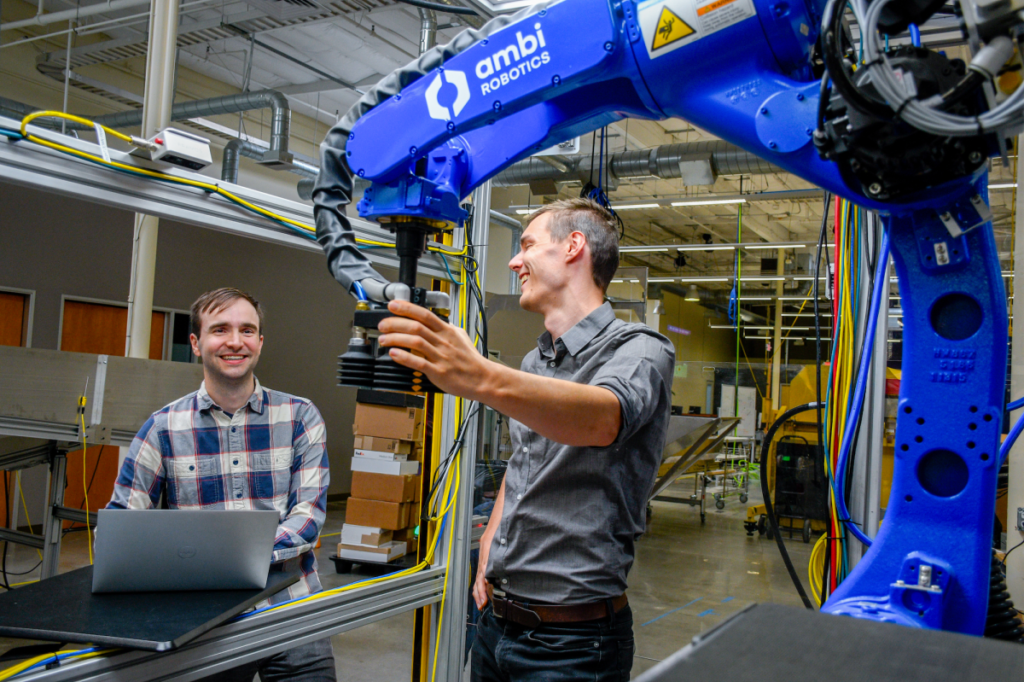
Unlike chatbot models, such as ChatGPT, which can train on an abundance of publicly available text datasets, DexNet didn’t have any preexisting data representing robot actions to train on. So, the team created a “video game” containing a vast database of three-dimensional shapes for their virtual robot to pick up. The more items it picked up, the higher the robot’s score. Across millions of iterations, DexNet learned to pick up objects it had never seen before by recognizing features like handles on mugs.
By 2017, the team had a real, working robot able to grasp objects with a 99% success rate. Their work caught the attention of the private sector, particularly retail and shipping companies, which saw the potential for a nimble, adaptive robotic arm to automatically sort irregular parcels. Amazon’s Jeff Bezos invited the team to a technology exhibition to present their innovation. During the presentation, a viewer threw their shoe into the input bin; without hesitating, the robot reached over, picked up the shoe, and moved it to the correct bin.
With their Ph.D. work complete, the team, eager to apply their academic advancements to solving real-world problems, founded Ambidextrous Laboratories in 2018 (later shortening the name to Ambi Robotics). As they developed their discoveries into commercial products, they quickly brought on CEO Jim Liefer, a logistics executive previously with Walmart and UPS, who had AI experience.
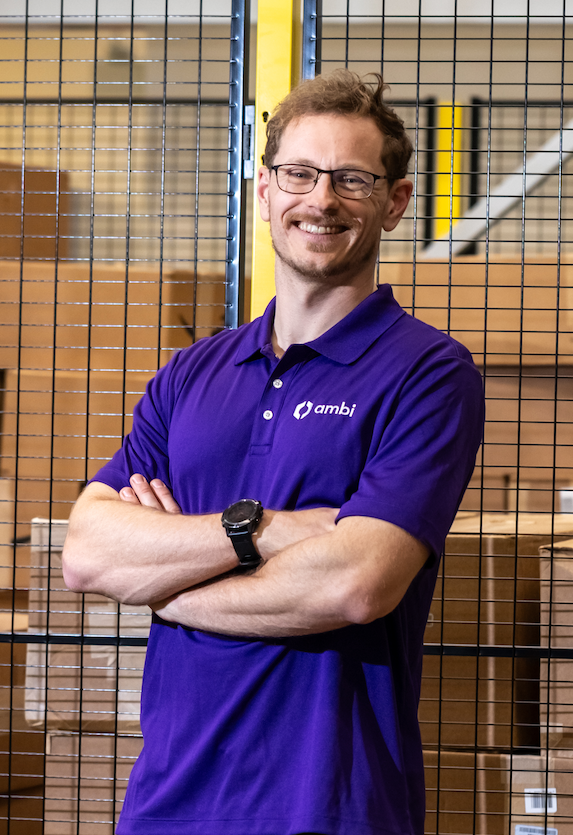
To finance their aspirations, they raised venture capital. Total VC investment in Ambi to date is roughly $70 million, and the company is currently raising a Series B funding round, said co-founder Stephen McKinley. (This from a guy who made his first robot as a kid, salvaging parts from the dump in his Massachusetts hometown.)
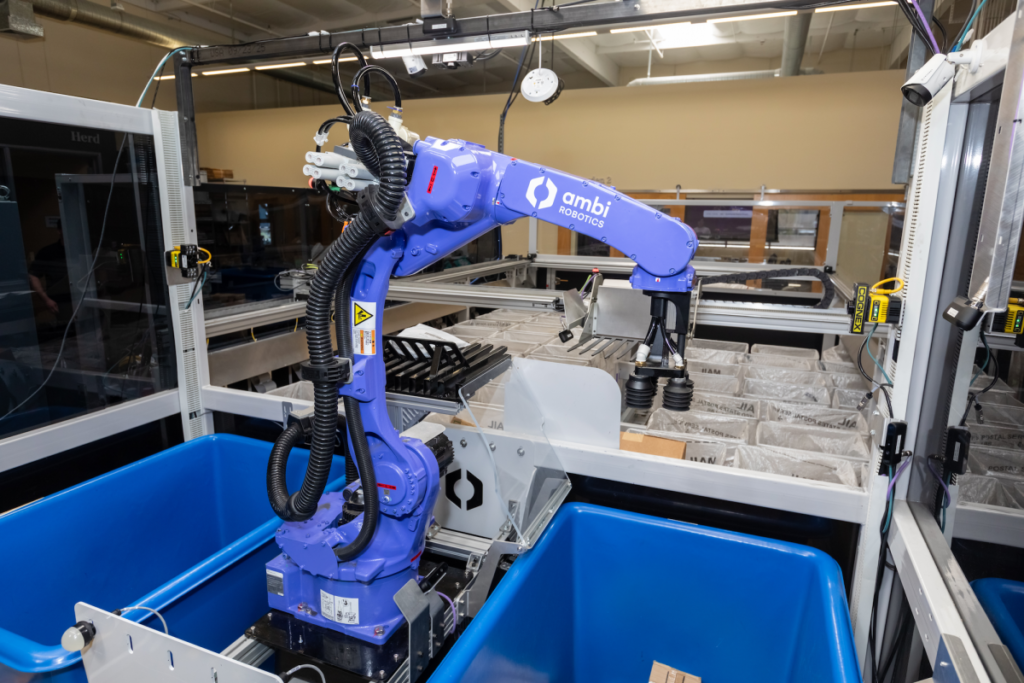
Today, Ambi’s two flagship products, AmbiSort and AmbiStack are deployed in the majority of U.S. states. The company counts major retailers, parcel delivery, and Fortune 500 logistics companies among its customers. Ambi robots have sorted more than 150 million objects over the past five years, McKinley said.
What happens to workers?
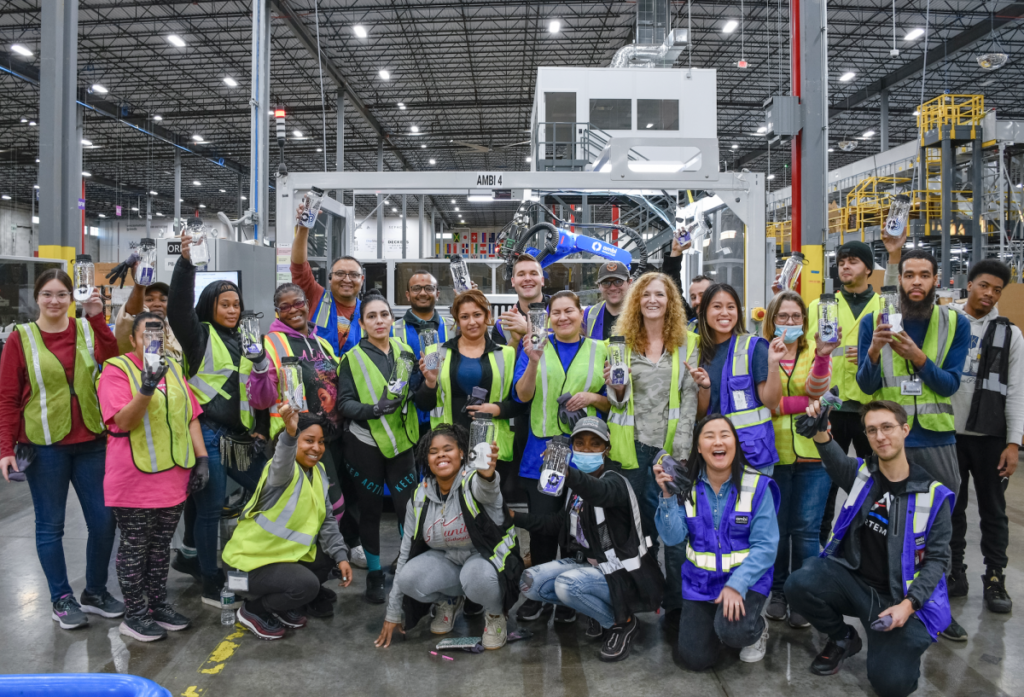
Warehouses and sorting facilities have long been a focus for automation. But with the introduction of truly dexterous robots in these increasingly automated workplaces, it’s natural to ask what role humans will play.
“We were always fascinated by the effect of technology on the workspace, and our hypothesis was that hopefully with more intelligent tools, you can create more or better jobs,” McKinley said. “Over the past five years at Ambi, we’ve been able to see the effects of automation on the workplace directly. We’ve found that working alongside robots uplifts working conditions.”
McKinley has been struck by how “proud workers are of what they’re doing,” he said. “It’s to the point of posting on social media or bringing their kids to see the robot that they work with. They’re excited to be exposed to technology. It literally changes the direction of their careers, because now they’re working on higher-tech things.”
Besides taking on a lot of the heavy lifting, the rise of robotics in logistics creates new categories of workers: robot operators and servicers. “We have field systems engineers located throughout the country that work with the robots, help install them, repair things and train people,” McKinley said. “That’s a critical job function at Ambi.”
For most of its existence, Ambi has focused on delivering fully integrated robot software and hardware. But that’s changing with the recent launch of AmbiOS. The company’s new AI Skills Suite decouples Ambi’s software from its hardware, allowing other companies to license the software for other industries and uses.
From working in Professor Goldberg’s lab to now leading the AI robotics startup, the founders say they have loved being a part of the Berkeley innovation ecosystem. In 2023, Ambi moved to its current office at the corner Fifth Street and Cedar Street (the former Annie’s factory), near the Fourth Street shopping district.
“We love being in the middle of a neighborhood with families, manufacturers, and great food, all in close proximity to the UC Berkeley talent base and hundreds of miles of trails,” McKinley said. “It’s that combo of high-tech, new thinking with grounded philosophies and community-based businesses that makes Berkeley so special.”
Startups in Berkeley

Berkeley is home to nearly 370 innovation companies, including 320-plus startups. More than 40 are in the AI and robotics industries.

The Berkeley Startup Cluster, a public-private-academic partnership managed by the City of Berkeley Office of Economic Development, strives to make Berkeley a more vibrant, accessible and equitable place for startups to launch and grow. The Cluster was honored last month for fostering the local innovation ecosystem at the UC Berkeley Chancellor’s Community Breakfast and as a “Catalyst” for East Bay innovation at the 2026 East Bay Innovation Awards. Ambi Robotics is a participant in the Cluster and won the 2025 East Bay Innovation award in the Design and Engineering category.

The city also partners with the Cal State University East Bay’s Institute for STEM Education and Berkeley High School to organize “STEM CareerX tours.” These give high school students exposure to local technology startups where they might apply their STEM skills to real world careers. Ambi has hosted student tours twice.
WHAT NEXT
- Subscribe to the Berkeley Startup Cluster newsletter to learn about other innovative Berkeley R&D companies — and events, news and opportunities for Berkeley startups.
- Attend the Berkeley Chamber’s annual Berkeley Today & Tomorrow lunch event, with a focus on how AI and Robotics will benefit the Berkeley economy.
- Visit the Discovered in Berkeley Stories page for more inspiration from innovative local businesses.